The first time I saw nuwa-skill, I thought it would be a “celebrity voice emulator.”
For example, you ask AI to speak in Steve Jobs’ tone, explain problems like Feynman, or analyze decisions like Munger.
These kinds of things are easy to write in a cliché way.
At best, it’s just quoting a few famous sayings.
At worst, it becomes role-playing gone too far.
But after reading its SKILL.md and the templates in references/, I realized it aims for something harder: it first breaks down a person’s way of thinking, then writes that into a runnable Skill.
This perspective deserves a separate discussion.
If you want to write a style Skill for your own public account, or create a “thinking consultant Skill” for a certain field, the structure of nuwa-skill is very instructive.
1. Clarify the Source First
The nuwa-skill repository is here:
https://github.com/alchaincyf/nuwa-skill
The repo is called “nuwa.skill.”
The README gives a straightforward usage: you can tell AI to “distill a Paul Graham,” “create a Zhang Xiaolong perspective Skill,” or “help me make a Skill for Duan Yongping.”
If you want to install it, just give AI this address:
https://github.com/alchaincyf/nuwa-skill
Then say:
Help me install the nuwa-skill from this repo.
This article mainly looks at three files:
SKILL.md
references/extraction-framework.md
references/skill-template.md
The repo also has many example character Skills, like Naval, Munger, Feynman, Karpathy, etc. They show that this method results in a complete Skill directory, not just a prompt snippet.
2. It First Clarifies What the User Really Wants
The entry design of nuwa-skill is quite interesting.
It doesn’t start by searching for information right away.
It first determines what kind of input the user has.
One type is a clear person’s name.
For example:
Distill Munger
Make a Feynman skill
This takes a direct path.
The other type is a vague user need.
For example:
I want to improve decision quality
Is there a way of thinking that can help me see through the essence of business?
This takes a diagnostic path. It will ask one or two questions first, then recommend suitable people or topics.
This step is very much like real consulting.
Many Skills are poorly written because they assume the user already knows what they want. But in reality, users often only know they are stuck and don’t know whose thinking style to turn to for help.
nuwa-skill splits the entry into “clear person name” and “vague need,” which is more user-friendly than a huge catch-all trigger list.
3. It Breaks Down Distillation into Six Research Areas
Once it gets into research, nuwa-skill divides information gathering into six directions:
01-writings.md       Works and systematic thinking
02-conversations.md  Long dialogues and spontaneous thinking
03-expression-dna.md Fragmented expressions and style DNA
04-external-views.md Others’ perspectives and critiques
05-decisions.md      Decision records and actions
06-timeline.md       Person’s timeline
This breakdown is important.
Only reading a person’s long writings tends to show what they want to appear like.
Only reading interviews can be misled by spontaneous expressions.
Only reading others’ evaluations easily becomes secondhand impressions.
So it keeps sources separate.
Works go under works.
Conversations go under conversations.
External evaluations go under external evaluations.
Decision records go under decision records.
This is enlightening for writing Skills: don’t mash all materials together. Separate by source and purpose first, then refine.
If we want to make a “public account article style Skill,” we can follow this approach:
01-published-articles.md   Published articles
02-editing-diffs.md        Draft-to-final edit records
03-reader-feedback.md      Reader feedback
04-style-rules.md          Explicit rules
05-boundaries.md           What not to write, what not to change randomly
First gather materials, then set rules.
4. How It Judges Whether a Viewpoint Is a Mental Model
In references/extraction-framework.md there’s a section I think is the most worth copying from the whole repo.
It says a viewpoint must pass three tests to be recognized as a mental model.
First, cross-domain reproducibility.
The same idea must appear in at least two different fields.
Second, generativity.
The model must be able to infer new problems, not just explain old materials.
Third, exclusivity.
It must reflect the person’s unique perspective, not common sense that all smart people would say.
These three points look like research methods but also suit writing Skills.
For example, if I say “articles should be conversational,” that’s not a good rule.
It’s too broad.
If instead it’s:
Don’t start with trends; start with a real pain point.
Don’t change technical explanations just to be conversational if it causes errors.
Don’t end with grand conclusions; return to what the reader can do next.
That looks like actionable rules.
Good Skill rules should trigger actions.
5. It Doesn’t Treat Style as Surface Tone
nuwa-skill has a term called “expression DNA.”
It looks at sentence length, question sentence ratio, analogy density, first-person usage, certainty tone, and frequency of transitions.
This part is easy to misunderstand as “learning catchphrases.”
But its real value is to prevent AI from only learning surface words.
A person’s style is obviously more than the words they like to use.
It also includes:
- Do they make judgments first or lay out evidence first?
- How do they speak when facing uncertainty?
- Do they admit when they don’t know?
- Do they prefer analogies or direct structural breakdowns?
- Are their criticisms sharp or more roundabout?
Writing these into a Skill makes it possible to reproduce consistently.
Just writing “speak like so-and-so” is basically useless.
AI will fill in a bunch of stereotypes.
6. It Writes Honest Boundaries into the Template
I really like that in skill-template.md there’s a section called “Honest Boundaries.”
It requires the generated character Skill to clearly state:
- What public information it’s based on
- When the research was done
- Which dimensions of information are lacking
- Which judgments are just inferences
- What this Skill cannot do
This is very important.
The more it’s “like a certain person,” the easier it is for people to mistakenly think it truly represents that person.
So boundaries must be clearly stated.
The same applies when writing a public account style Skill.
For example, a Skill can help you keep article rhythm but can’t judge if facts are correct.
It can remind you where you sound AI-ish but can’t guarantee readers will like it.
It can learn your expression preferences from old articles, but the old articles themselves may have issues.
Writing these boundaries makes the Skill trustworthy.
7. What It Inspires for Writing Your Own Skill
What’s most worth learning from nuwa-skill is not the “distilling celebrities” topic.
What’s truly worth learning is this structure:
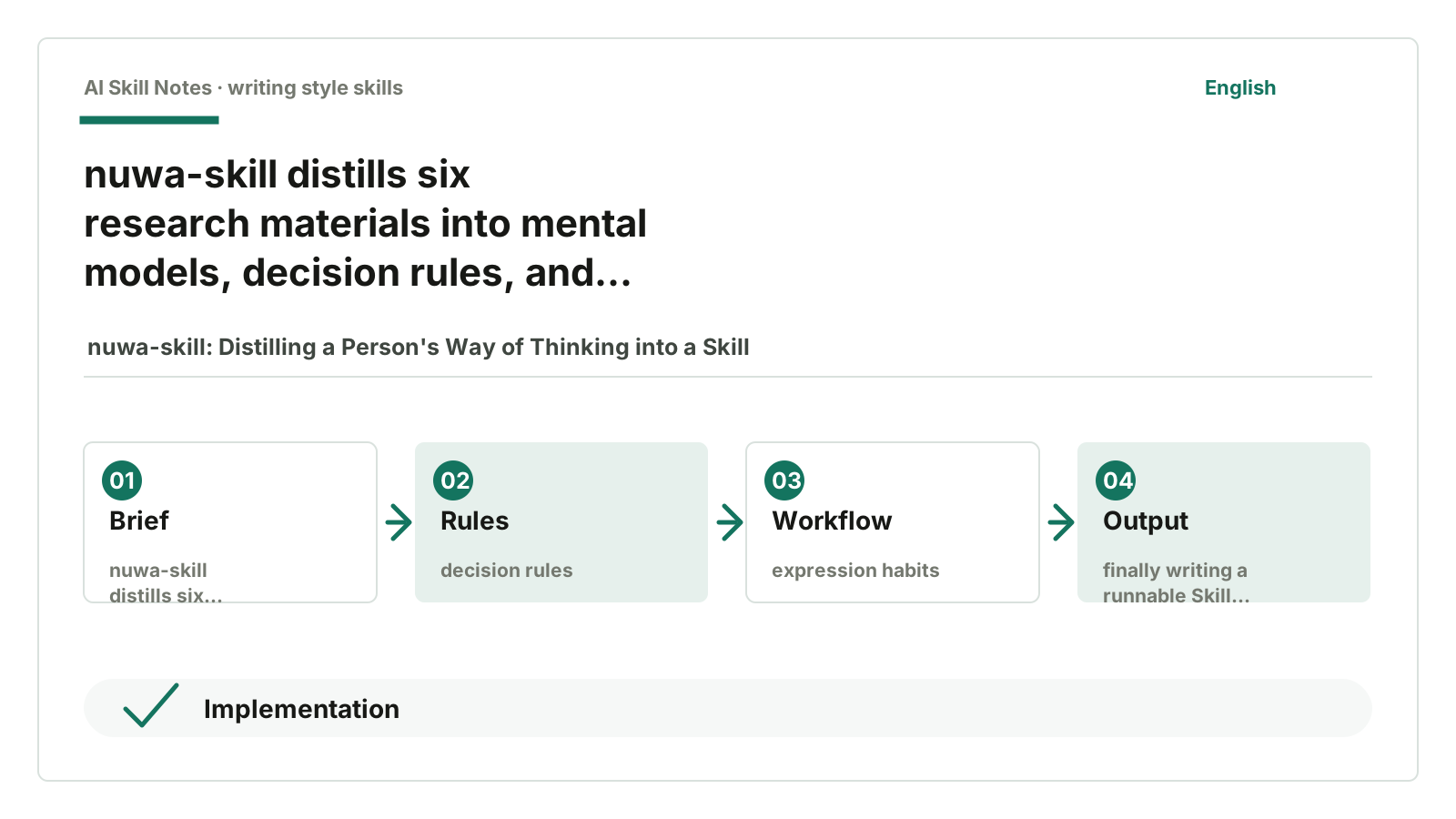
First clarify user needs
Then break down material sources
Then extract mental models
Then write expression rules
Finally add honest boundaries and quality checks
If you want to write your own “public account article style Skill,” you can borrow this framework.
Don’t start with:
Please write articles in my style.
That’s too vague.
Instead, prepare first:
10 articles you’re satisfied with
3 drafts you’re not satisfied with
Several draft-to-final diff sets
Common headline styles
Common banned phrases
Article structures that suit you
Fact and terminology protection rules
Pre-publish checklists
Then have AI help you turn these materials into a Skill.
This is much more reliable than writing a prompt based on feeling.
8. My Judgment
nuwa-skill is somewhat ambitious.
It’s not a minor writing tool. It wants to make a person’s way of thinking into a transferable Skill.
This is hard and naturally has boundaries.
Public materials don’t equal real thoughts.
Expression style doesn’t equal judgment ability.
Character Skills shouldn’t be treated as the actual person’s stand-in.
But its process design is worth learning: materials layered, judgments verified, output self-contained, boundaries clearly stated.
For us doing content writing, this insight is direct.
Don’t just let AI learn “my tone.”
First organize how you judge, how you choose, how you revise, what you absolutely won’t write into rules.
That’s the style that can truly be reused.